

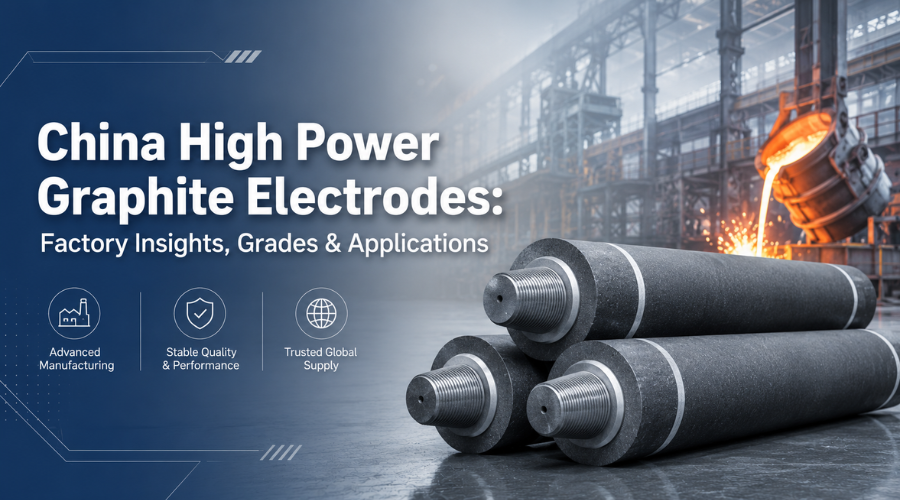
Among metallurgical factory operations, the Electric arc furnace (EAF) or ladle furnace (LF) operations, is a procedure involving extreme heat, relentless pressure, and razor-thin margins. In that environment, the graphite electrode is not just a consumable component. It is an item that is responsible for making the entire melting process effective. When it performs well, the furnace operates seamlessly, the energy bills stay predictable, and the steel flows. When it fails well, you already know the cost of unplanned downtime, broken columns, and off-spec heats.
If you are an operational professional new to metallurgical and steel factory operations, the learning curve can feel brutal. You have to get acquainted with acronyms like RP, HP, UHP, CTE, and NEMA, and the pressure to select the right product for your furnace can be overwhelming. That is precisely why we are focusing on China High Power Graphite Electrodes. They represent the Goldilocks zone of the electrode world: significantly better performance than standard grades, without the premium price tag of the ultra-high-power variants.
But the secret to successful plant operations doesn't come from buying the most expensive electrode; it comes from buying the right electrode and using it correctly. This blog will not confuse you with unnecessary technicalities. It will hand you the practical, factory-level insights you need to make confident decisions. We will look at the hard performance stats, demystify factory production, and ultimately help you transform a major operational expense into a manageable, predictable component of your steelmaking success.
Before we dive into the specifics of HP, let’s establish one thing. Not all graphite electrodes are created equal. They are classified by their ability to handle current density—essentially, how much electrical energy you can push through them without causing premature failure.
Just as you wouldn't use a lightweight jumper cable to pull a fully loaded trailer, you wouldn't use an industrial-grade chain to jump-start a motorcycle. The same principle applies here.
RP (Regular Power): These are the entry-level workhorses. With a current density of 14-18 A/cm², they are best suited for smaller furnaces or non-ferrous smelting operations where electrical demand is moderate.
HP (High Power): Operating at 18-25 A/cm², these electrodes deliver outstanding performance for medium to large EAFs and ladle furnaces. They are manufactured using a blend of premium petroleum coke and a significant portion (around 30%) of needle coke. This specific cocktail of raw materials gives them superior conductivity and thermal shock resistance.
UHP (Ultra High Power): The heavy hitters. With current densities exceeding 25 A/cm², these are reserved for large-capacity, high-intensity furnaces that run 24/7 and demand peak performance. They are also significantly more expensive.
For most operational professionals in the metallurgical industry, the HP offers the perfect balance between cost and performance. Why? Because it offers a tangible leap in efficiency and durability compared to RP, yet it remains significantly more budget-friendly than UHP. It is the smart, practical choice for many steelmaking scenarios.
Now, let us consider some performance specs that show the enormous potential of HP electrode in the operating environment. In a steel mill, data is your best friend, and these are the metrics that will directly impact your bottom line.
The lower the resistivity, the better. For HP electrodes, the body usually has a resistivity of 5.5-7.0 μΩ·m. The crucial connecting nipples are even lower at 4.0-5.5 μΩ·m. Lower resistivity means electricity moves through the electrode with less resistance. And with less resistance comes lower energy consumption during the melt. That definitely counts towards efficiency and is money saved on your power bill.
This is a measure of how much material is packed into the electrode's volume. HP electrodes usually range from 1.62 to 1.73 g/cm³. Higher density is a great indicator of quality. Denser electrodes are harder and less porous, which means they are more resistant to oxidation (burning away on the surface) and will last longer in the furnace.
This is about mechanical toughness. HP electrodes maintain a flexural strength of ≥ 11.0 MPa. During operation, the electrodes are subjected to immense mechanical forces as they are raised, lowered, and struck by falling scrap. They also experience violent thermal shocks when the furnace fires up. High flexural strength ensures your electrode column doesn't snap under pressure, preventing those dreaded and costly breakages.
CTE measures how much the electrode expands when it gets hot. A lower CTE (for HP, typically 1.65-2.25 × 10⁻⁶/°C) is a huge advantage. It means the electrode is less susceptible to cracking when the furnace temperature changes rapidly. The lower CTE acts as a thermal shock absorber for your operation.
Simply put, you want as little ash as possible. HP electrodes generally have ≤ 0.3% ash. Ash is impurities, and when they burn off, they can contaminate your steel bath and cause inclusions. Lower ash means cleaner steel and fewer rejected heats.
When you buy China High Power Graphite Electrodes, you are buying the result of a complex, high-tech manufacturing process. Reputable factories in China follow rigorous quality controls to ensure the final product performs reliably in extreme operational environments.
It all starts with the raw materials. The "secret sauce" of HP electrodes is a precise mix of calcined petroleum coke and high-quality needle coke. The needle coke, with its unique crystalline structure, is the main material that makes low resistivity possible. It also delivers high strength, which we discussed earlier. Top-tier Chinese factories are transparent about their sourcing, often using premium imported needle coke.
The journey from raw powder to a solid graphite column involves a series of procedures
1. Preparation and Mixing: The materials are crushed to precise particle sizes. They are then weighed and mixed with coal tar pitch to form a dense paste.
2. Extrusion: This paste is then pressed into massive, green electrode blanks using an extrusion press.
3. Baking: The blanks are slowly baked in massive furnaces at high temperatures. This hardens the structure and carbonizes the binder.
4. The HP Advantage - Impregnation: This is where HP gets its edge. The baked electrodes are impregnated with hot pitch under pressure to fill microscopic pores. This can be done multiple times to achieve that higher density and lower resistivity characteristic of the HP grade.
5. Graphitization: The blanks are heated to over 2,800°C in a graphitization furnace. This intense heat transforms the amorphous carbon into crystalline graphite, giving the electrode its outstanding electrical and thermal properties.
6. Precision Machining: Finally, the graphitized electrodes are machined to exacting international standards (like NEMA CG 1 and IEC 60239). The threads on the nipples are cut with incredible precision to ensure a tight, secure connection.
A good HP graphite electrodes manufacturer doesn't just churn out product; it tests it religiously. Look for factories with ISO 9001 certification. They will test every batch for the key specs we listed earlier resistivity, density, strength, and CTE. This relentless focus on QC is what protects you from receiving a bad batch that could derail your production schedule.
This is the primary stage, the heart of the steelmaking process. In an EAF, an incredible amount of electrical energy is discharged through the electrodes to generate an arc that can reach 3,000°C. The scrap metal melts in this electric inferno. It is an aggressive, violent process. HP electrodes are up for the task, providing the robust, conductive path needed to melt a charge efficiently.
As a starting point, a modern EAF can consume 3 to 5 kg of electrode per ton of steel produced. This number, however, is a compass, not a rule. It varies wildly based on the quality of your scrap, the power you are applying, and the specific operational practices you employ. This is why tracking your own consumption data is so vital.
After the steel is melted in the EAF, it is tapped into a ladle for secondary metallurgy. The core function of LF electrodes in LF is to maintain temperature and facilitate complex alloy additions, rather than the melting of scrapons. The power needed is lower, and the environment is less aggressive, but the requirements for stability and reliability remain. Consumption here is generally lower, averaging around 1 kg per ton.
Beyond steel, HP electrodes are also the go-to choice for electric smelting furnaces in the production of industrial silicon, ferroalloys, and calcium carbide. Wherever intense heat under controlled conditions is required, you'll find a reliable HP electrode at the center of the action.
Choosing a Chinese supplier can feel challenging, as there are so many options and it is easy to get lost. However, if you know what to look for, you can find a partner who will be an asset, not a liability. Here are the key criteria:
A serious HP graphite electrodes manufacturer will have a substantial footprint think production facilities over 30,000 square meters and multiple production lines. They will often showcase their annual output, which can be in the region of US$5-10 million in capacity. This scale speaks to their experience and ability to fulfill large, consistent orders.
Do they hold ISO 9001? Examine if they have a solid track record of exporting to demanding Western markets. A supplier experienced in fulfilling the strict quality requirements of the EU or US is more likely to deliver a premium product.
Don't be shy to ask directly: "Where does your needle coke come from?" Reputable factories use premium raw materials and are proud to share their sourcing.
Finally, let's talk size. HP graphite electrodes are available in a wide range of diameters, from small 200mm columns to giant 700mm ones. The right diameter for you depends entirely on the power capacity of your furnace. Selecting an electrode that is too small is a danger to your operation, potentially leading to overheating and failure. Selecting one that is too large means you are overpaying for capacity you will never use.
|
Diameter (mm) |
HP Current Capacity (A) |
HP Current Density (A/cm²) |
|
300 |
13,000 - 17,400 |
17 – 24 |
|
350 |
17,400 - 24,000 |
17 – 24 |
|
400 |
21,000 - 31,000 |
16 – 24 |
|
450 |
25,000 - 40,000 |
15 – 24 |
|
500 |
30,000 - 48,000 |
15 – 24 |
|
550 |
35,000 - 55,000 |
14 – 22 |
Use this table as your initial guide, but always align your final selection with your specific transformer capacity and furnace design specifications.
A high-temperature furnace operation is always difficult to manage, and nailing the melting part requires skill as well as furnace parts that can handle the intense atmosphere. The consequences of poor decisions are felt immediately in downtime and lost production.
However, by taking the time to understand the fundamentals of China High Power Graphite Electrodes, you now know that success is not just about buying an electrode. It is about understanding the manufacturing process, respecting the critical performance specs like resistivity and density, and knowing exactly what to look for in a capable factory partner.
You aren't just managing a consumable; you are optimizing a process. That means hitting the peak in all KPIs like breakage risk, energy consumption, and better steel quality. Your operation becomes more predictable, your costs more controllable, and your furnace a reliable engine of profit.
What makes China’s graphite electrodes stand out?
China’s factories combine large-scale production capacity with strict quality control. Buyers get electrodes that balance conductivity, durability, and cost efficiency ideal for steelmaking and industrial furnaces.
Which grades of High Power graphite electrodes are available?
Factories supply standard HP, SHP, and UHP grades. Each grade is tailored for different current loads and furnace sizes, giving buyers flexibility for steel plants, foundries, and alloy production.
Where are graphite electrodes used?
They power electric arc furnaces, ladle furnaces, and smelting operations. Applications range from steel recycling to non-ferrous metal refining, making them essential in heavy industry worldwide.


Have a question or need a quote? Fill out this form and our team will get back to you quickly!
 jack@sinometalunion.com


 +86-411-39625877