

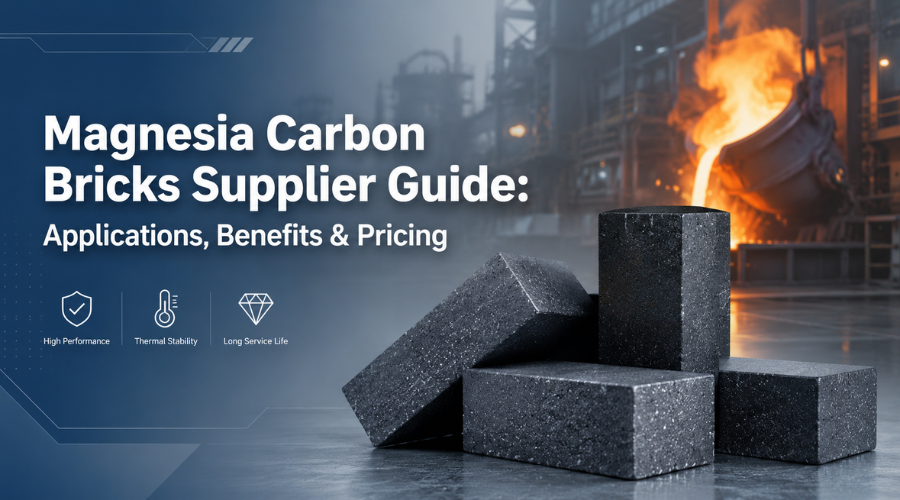
The iron and steel industry is among the giants of the global commodities. Many industries like construction, automotive, aerospace, machinery, and arms fully rely on this industry, and this industry relies on its smelting operations. Its smelting operations have to rely on refractory bricks of MgO-C, and you can imagine how crucial they are. The metal industry heavily relies on a bulk magnesia carbon bricks distributor to keep the smelting operations going. These refractory bricks are like the primary support for the entire smelting operation. Here is all you need to know about magnesia carbon bricks if you came here for a complete guide.
The production process of magnesia carbon bricks consists of a few main steps. Whether you want standard magnesia bricks or fused magnesia bricks, the process is similar. What differentiates them is the purity level and the composition used in them. Here are all the steps you can find.
Magnesia and graphite are the two main materials that contribute to making magnesia bricks. Besides, manufacturers use additives and binders in the production. Since fused magnesia bricks require high purity, their composition is slightly different from that of basic magnesia bricks. Basic bricks contain magnesium 80% to 90%, carbon 8%-18%, phenolic resin around 3%, and additives around 1% to 2%. The composition varies as per the requirements.
Then the kneading and mixing process starts, where manufacturers make a balanced mixture. To manufacture high-quality wholesale refractory bricks, this process contributes a lot. The composition and mixing of materials have to be consistent for the sake of consistent quality of magnesia carbon bricks. Any inconsistent step can affect the overall density, shape, thickness, and strength of bricks.
After it, the molding process takes place. This process is the second last step, where heat treatment and molding take place. Under high temperature and pressure, the magnesia carbon mixture further tightens and takes the required form. This temperature is between 100 degrees C and 250 degrees C, usually. This temperature triggers the binder in the mixture to slowly bind the material together. The bricks become solid and stable with the help of heating the binders.
The molding process also has to be consistent for all batches because each brick contributes to the success of the furnace’s interior lining. So, the molding machine gives a precise shape to all the bricks in each batch.
Once the molding process completes, all the bricks have to go through the curing process. It is the last step that ensures the surface and the binders are intact. The molding process activates the binder, and the curing process finalizes the production. The curing temperature is near 150 degrees C, which smooths the surface of the bricks. If there is any flaw left after the molding process, the curing process eliminates it. It further hardens the binders to ensure the bricks can withstand the extreme temperature of over 1000 degrees C in a furnace.
Industrial users know the working process of magnesia carbon bricks. They know about it, and this is why they look for high-grade wholesale refractory bricks. These bricks provide a stable and unbreakable support in the interior of different kinds of furnaces. Withstanding extreme heat, pressure, and corrosion risk is not possible for any ordinary brick. Only refractory bricks of magnesia carbon can do that. They bear the heat continuously without showing any signs of cracking or degradation.
Magnesia carbon bricks work as a protective lining that creates a buffer zone between the steel shell and the molten steel. Their remarkable performance in furnaces makes them one of the best choices for interior lining. That is why smelting industries partner with a bulk magnesia carbon bricks supplier. They need a supplier who can supply heavy-duty refractory bricks for EAF, BOF, ladles, and various other types of furnaces. Here are all the types of applications in detail.
The working temperature of any EAF is over 1500 degrees C. Not any ordinary brick can withstand such thermal heat pressure, and only fused magnesia bricks can do that. These refractory bricks provide unshakable support in the smelting process without downgrading the performance. The quality of metal production meets a high success rate with the help of magnesia carbon brick lining. These refractory bricks withstand not only thermal shocks, but also corrosive and abrasive threats from the slags in EAF.
In continuous casting, these MgO-C bricks provide different types of support. They support the ladle as well as other containers in the entire continuous casting process. Usually, they provide mega support to ladles where the interior lining is made of MgO-C bricks. The molten metal is extremely hot with highly corrosive slag. To protect the shell from damage, these MgO-C linings resist thermal shocks, cracks, and various other threats for repetitive operations.
Then another type of furnace requires a protective lining inside it. That is BOF, and its entire interior lining is made up of magnesia carbon bricks. The stable and smooth layer of magnesia carbon bricks contributes to high-quality steel production. Basic oxygen furnaces require wholesale refractory bricks for the best results. They have to source standard and also custom sizes for the desired smelting outputs. There is also a risk of corrosion, abrasion, and cracks, but these interior linings of refractory bricks withstand all threats.
The smelting industry or foundries need wholesale refractory bricks to keep the operations going. They have to replace them after some time, depending on the usage level. However, these MgO-C bricks provide long-term support against all kinds of extreme threats like thermal heat, pressure, shocks, abrasions, and corrosion. They maintain a solid and unshakable interior lining to provide successful smelting results. The smelting process can tear apart any ordinary protective lining, and the magnesia carbon bricks are among the best solutions for them.
The first advantage of MgO-C bricks is that they contribute massively to steel production. The quality of metal, its surface, and durability also depend on the furnace’s quality. The furnace’s quality depends on the interior lining, which is in direct contact with the molten metal. Refractory bricks have to be really heavy-duty and dense against continuous heat and pressure. Since these magnesia carbon bricks do not degrade easily, industries consistently rely on their support.
The second biggest advantage of refractory bricks is that they can withstand extreme heat. Magnesia carbon linings can withstand up to 1700 degrees C. They resist heat and thermal shock to show high degradation resistance. It is another reason why furnaces need wholesale refractory bricks in consistent quality. This thermal heat resistance makes them crack-resistant. These bricks can show stability against an increase and decrease in heat. Variable thermal stress can not cause any cracks or abrasions in the magnesia refractory bricks.
Then there is a risk of massive corrosion and degradation, which could happen from the corrosive slag. Slag is a common byproduct in the smelting process, and to deal with it, the same magnesia bricks work. They resist slag corrosion, which can leach the magnesia or carbon from the ordinary refractory bricks. Therefore, heavy-duty magnesia carbon bricks work as a protective lining inside all kinds of furnaces. Such protective lining reduces the risk of abrasion from slag.
Some industries especially look for fused magnesia bricks for the highest level of advantage. That advantage comes in the form of high heat retention. In the furnace, that heat retention contributes to a cost-effective solution. If the furnace bricks retain heat longer, there will be less thermal fuel required in the smelting process. That heat retention contributes to some energy savings because the bricks hold heat to keep the process going actively. Therefore, heat retention is another advantage that furnaces get from magnesia carbon bricks.
These refractory bricks of magnesia carbon are still a cost-effective solution in this modern age. They provide a cost-effective protective layer in the large-scale smelting process. It affects the ROIs of industries that deal in this process. They prefer to procure magnesia bricks from wholesalers that can offer better discounts than others. As a result, the final output becomes cost-effective.
These refractory bricks of magnesia carbon provide long-term support through their intense defense. They can withstand all kinds of thermal and corrosive threats inside a furnace without showing any risk of cracks. Cracks as well as abrasions fail to occur on the bricks for a long time.
There are some very prominent names in the industry, and some are rising ones. It is better to know a few names that can supply high-grade wholesale refractory bricks at an affordable price. These suppliers are Sinometal Machinery Corp, Zhengzhou Rongsheng Refractory Materials Co., Ltd., and Zhong Tang (Dalian) Materials Co., Ltd. However, you can further do research and find some other names depending on your requirements.
Sinometal Machinery Corp is a bulk magnesia carbon bricks supplier you can explore. It has superior magnesia carbon bricks for electric arc furnaces and also for other types. It is a certified manufacturer that complies with ISO standards. It seems to be a manufacturer that can offer high material purity for high efficiency. Likewise, you may find it provides precise material composition, quality consistency, and durability. You can contact it for a quotation and inquire about customization. This manufacturer has a global supply, which can help many foundries worldwide.
The second supplier is Zhengzhou Rongsheng Refractory Materials Co., Ltd. It is also a certified one, and it complies with SGS, CE, TUV, INTERTEK, etc. You can ask for customization in different shapes and sizes of magnesia carbon bricks. You may find some other compositions of refractory bricks on the website. This supplier has exported to more than 120 countries so far. Its sales and service outlets exist in around 30 countries.
The third is Zhong Tang (Dalian) Materials Co., Ltd., which manufactures magnesia carbon bricks for various kinds of furnaces. You can find compatibility of bricks with BOF, EAF, ladle, and various other steel-making furnaces. This supplier also provides custom sizes and material composition. It has supplied material to around 15 countries so far. You can inquire about a quotation and other details by contacting this supplier.
Various factors affect the price of magnesia carbon bricks. The material purity, quantity of bricks, supply chain factors, and all the secondary costs contribute to it. The best way to find estimated prices of refractory bricks is through supplier analysis. You need to find some reliable suppliers in the industry, ask for a quotation, and then do a cost analysis. There are lots of factors that contribute to the price of magnesia carbon bricks. So, you will have to find some suppliers first.
Refractory bricks are the foundation of smelting furnaces. They hold together the molten metal by withstanding extreme heat, corrosion, abrasion, and shocks. To withstand all these threats, interior linings of furnaces require these refractory bricks, and one of the best choices is magnesia carbon bricks. They are a cost-effective, long-lasting, and extremely resistant material for multiple types of furnaces. They are a competent choice for EAF, ladle, and BOF linings.
Where Should I Procure Wholesale Refractory Bricks of Magnesia Carbon From?
You can find suppliers on B2B platforms like Alibaba.com, Made-in-China.com, or Tradewheel.com. There is another option, and that is Sinometal Machinery Corp. You can try this manufacturer for heavy-duty magnesia carbon bricks.
Who are Some Global Magnesia Carbon Bricks Manufacturers?
Sinometal Machinery Corp, Zhengzhou Rongsheng Refractory Materials Co., Ltd., and Zhong Tang (Dalian) Materials Co., Ltd. are some global manufacturers. Besides, you can also find some other names, but you will have to do a complete analysis for that.
Who Can Supply Large Volumes of Magnesia Carbon Bricks at Competitive Prices?
A bulk manufacturer can do that, especially someone who has the capacity to manufacture tons of MgO-C bricks. One of the reliable suppliers you can try is Sinometal Machinery Corp. It is a certified manufacturer with competitive prices and a global supply.
Can Any Manufacturer Supply Custom Magnesia Carbon Bricks?
Yes, some manufacturers can provide customization. Sinometal Machinery Corp is one of those manufacturers that can do that. You can find some more custom manufacturers on B2B platforms like Made-in-China.com.


Have a question or need a quote? Fill out this form and our team will get back to you quickly!
 jack@sinometalunion.com


 +86-411-39625877