

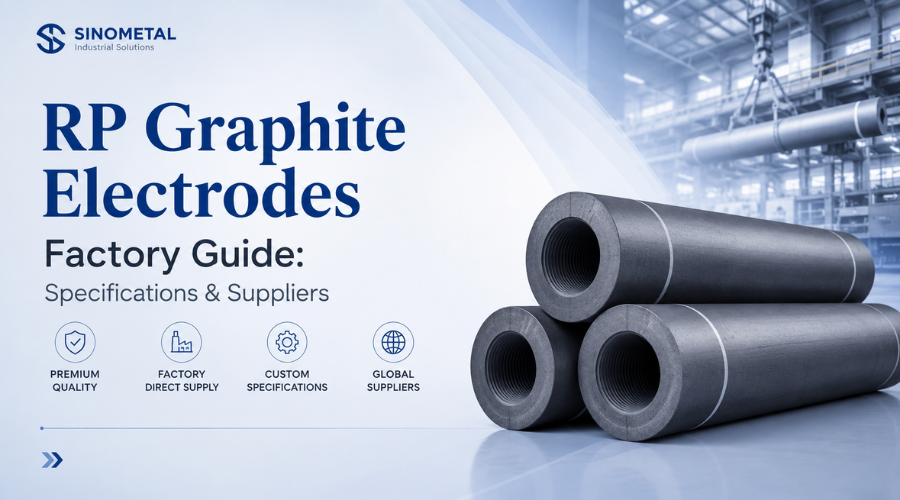
Electric arc furnace (EAF) or ladle furnace (LF) operations are the core processes of steelmaking, and making this process efficient means your steel factory will be able to hit each and every performance, production, and profitability goal. But the reality is too many operational professionals underestimate the role of the graphite electrode in furnace operations, and it is just treated as a consumable. And that is a mistake.
The electrode is the pipeline through which all your melting power flows. When it performs reliably, your furnace runs smoothly. When it fails, the result is poor furnace performance with higher operational costs and unplanned downtime.
That is precisely why we are focusing on RP (Regular Power) graphite electrodes. They are the entry-level component of the industry, and for many operations, they are exactly the right tool for the job. Affordable, dependable, and widely available from Chinese factories, they represent the foundation upon which consistent steelmaking is built.
This blog is designed to cut through the confusion. We will give you the hard performance stats that matter, discuss what makes China regular power graphite electrodes better than others, and help you understand exactly where RP electrodes fit into your operation. By the end, you will not just know what an RP electrode is—you will have the confidence to select the right supplier and turn this essential consumable into a predictable, controllable part of your process.
In simple terms, a graphite electrode is a conductive rod that carries the massive electrical current needed to melt scrap steel in an EAF (Electric Arc Furnace). It’s structure is made from a blend of calcined petroleum coke and coal tar pitch, which is then molded, baked at high temperatures, and finally graphitized in furnaces exceeding 2,800°C. This extreme heat transforms the carbon structure into crystalline graphite, giving the electrode its unique conductive properties.
The classification system—RP (Regular Power), HP (High Power), and UHP (Ultra High Power) is based on how much current the electrode can safely handle. This is measured as current density, typically expressed in A/cm². For RP electrodes, this density falls between 14 and 18 A/cm² . That is noticeably lower than HP or UHP grades.
Why the difference in current handling? It comes down to raw materials. While HP and UHP electrodes incorporate significant amounts of high-performance needle coke, RP electrodes are made primarily from petroleum coke. This makes them more affordable but also limits their performance under extreme thermal and mechanical stress.
So, what does this mean for you in practical terms? RP electrodes are best suited for smaller to medium-sized EAFs, ladle furnaces, and submerged-arc furnaces used in ferroalloy and silicon production . They are the sensible, cost-effective choice when your furnace demands are moderate and you need a reliable, budget-friendly solution.
In a steel mill, performance data drives every operational decision. So, understanding the key performance specs for RP electrodes means you can take the correct measures to raise productivity. Here are the core specifications you should consider, with typical performance ranges.
This measures how compact the electrode material is. RP electrodes generally have a bulk density of 1.52 to 1.65 g/cm³. A higher density within this range generally translates to better oxidation resistance and a longer service life in the furnace.
Think of this as the electrode's resistance to the flow of electricity. Lower is better. For RP electrodes, resistivity falls between 7.0 and 9.0 μΩ·m for the electrode body. This is noticeably higher than HP grades (which are around 5.5-7.0 μΩ·m), meaning you will experience slightly higher energy loss. It is a trade-off for the lower cost.
This measures mechanical toughness. RP grade flexural strength ranges from 6.4 to 11.0 MPa, depending on the diameter. Larger diameter electrodes tend to have lower flexural strength, a factor worth considering if your furnace operation involves significant mechanical shocks from scrap charging.
This measures how much the electrode expands when heated. A lower CTE indicates better thermal shock resistance. For RP grade, CTE (100-600°C) is generally 2.00 to 2.90 × 10⁻⁶/°C . This is higher than HP. This means RP electrodes have a higher risk for cracking during rapid temperature changes.
Lower ash content is better to prevent contamination of the steel bath. For RP electrodes, ash content is typically 0.3% to 0.5% .
China leads in the production of RP graphite electrodes. The best manufacturers operate on a massive scale. A typical reputable factory might have an annual output value between US$5 million and US$10 million, with facilities spanning over 30,000 square meters and multiple production lines
An authentic and genuine RP graphite electrode factory follows a rigorous, multi-step process:
1. Raw Material Crushing and Batching: High-quality calcined petroleum coke and other materials are precisely ground and measured.
2. Kneading: The materials are mixed with a coal tar pitch binder to form a homogenous paste.
3. Forming: The paste is extruded or vibration-molded into large, "green" electrode blanks.
4. Baking: The blanks are baked in controlled furnaces to harden the material.
5. Impregnation (Optional): For a higher-grade version, called RPI, the baked electrode is pitch-impregnated to increase density and strength.
6. Graphitization: The electrode is fired in an electric furnace at temperatures over 2,800°C. This is the critical step that transforms the carbon structure into graphite, giving it its conductive properties.
7. Machining: The final product is precision-machined to exact specifications, often meeting international standards like NEMA CG 1 and IEC 60239 . The nipples—which connect individual electrode segments—are cut with precise tapered threads (typically 3 or 4 threads per inch) to ensure a secure connection .
The best factories are transparent about their quality control. Look for ISO 9001 certification, which indicates a commitment to systematic quality management. They will also conduct rigorous testing on every batch for the key performance specs listed above.
China regular power graphite electrodes are versatile but are best suited for specific applications where the furnace demands are lower.
• Electric Arc Furnaces (EAF): They are widely used in smaller to medium-sized EAFs. A common baseline for consumption in an EAF is 3-5 kg of electrode per ton of steel produced . This number, however, is a starting point, not a rule. It varies based on scrap quality, power input, and operational practices.
• Ladle Furnaces (LF): Here, they are used for refining and maintaining temperature. Consumption is lower, around 1 kg per ton of steel .
• Other Smelting: They are also used in submerged-arc furnaces for producing ferroalloys, industrial silicon, yellow phosphorus, and calcium carbide.
RP electrodes are available in diameters from 75mm to over 700mm. The current carrying capacity varies significantly with size. Here is a practical reference table:
300 10,000 – 13,000
350 13,500 – 18,000
400 18,000 – 23,500
450 22,000 – 27,000
500 25,000 – 32,000
550 32,000 – 40,000
Choosing a factory is about finding a reliable partner who will deliver consistent quality. Here is what to look for:
1. Certifications and Scale: Look for ISO 9001 certification and evidence of a substantial factory footprint (e.g., over 30,000 m²) with multiple production lines.
2. Raw Material Sourcing: Ask about their supply chain. Are they using high-quality domestic or imported petroleum coke? Transparency here is a good sign.
3. Quality Control: Inquire about their testing procedures. A good factory will conduct rigorous tests on every batch for the key performance specs listed above.
4. Export Experience: Check their main markets. A supplier experienced in exporting to demanding markets like North America or Western Europe is likely to maintain consistent quality standards.
Conclusion
Understanding regular Power graphite electrodes is the first step towards optimizing your furnace operations and controlling costs. Since you have read the blog, now you know the core specs—density, resistivity, and strength.
But the real success happens when you can apply this knowledge. That happens when you next evaluate a supplier, you will be equipped to ask the right questions about raw materials, production processes, and quality control. You will not just be buying an electrode; you will be investing in a predictable, efficient process for your steel mill.
1. Which specifications should I order?
Match electrode diameter and grade to your furnace load. The wrong size increases energy use and reduces efficiency.
2. How do I verify product quality?
Request certifications and batch test reports. Reliable suppliers provide documented performance data to ensure consistent results.
3. What drives pricing differences?
Costs vary by raw material, process, and supplier reputation. Focus on total cost of ownership delivery, downtime risk, and service not just the lowest upfront price.


Have a question or need a quote? Fill out this form and our team will get back to you quickly!
 jack@sinometalunion.com


 +86-411-39625877